
Last updated:
The preparation phase may take between 2 to 4 months before finalizing the process of admitting the bonds to trading. The preparation phase (as the planning phase) will vary greatly dependent on several factors such as: the Company´s development stage, if it is the first issuance or not, if you have a base Prospectus, if the Company will launch a public or private offer and if you chose a regulated market or an MTF for listing.
What are the necessary preparation steps you need to take?
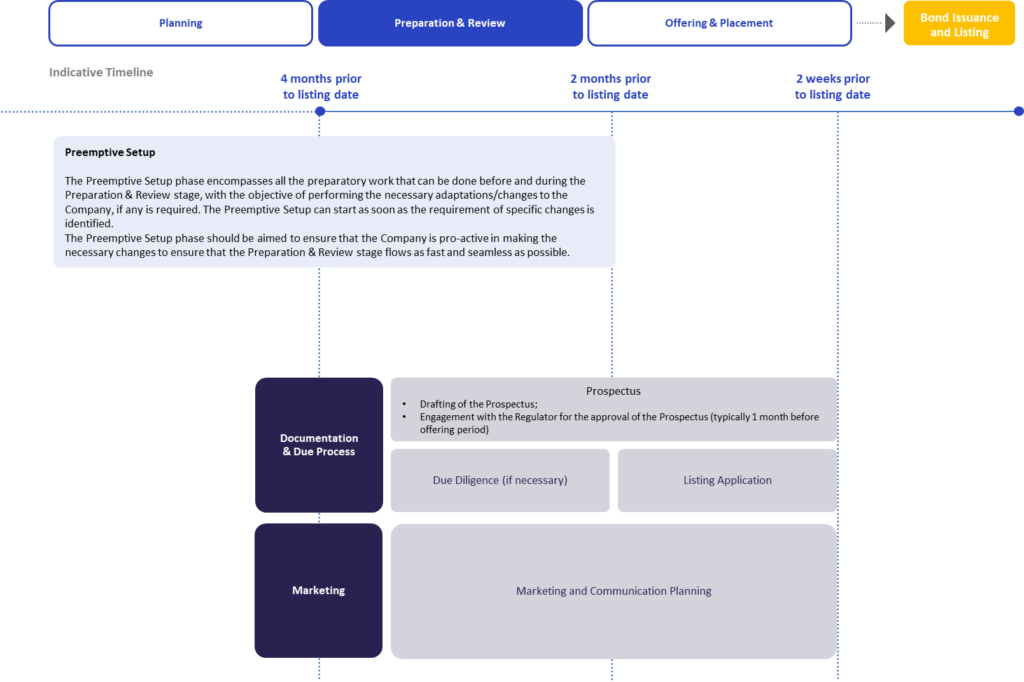
4.1.1.2.1. Preemptive setup
4.1.1.2.1.1. Kick-off meeting
Once all members of the Bond Offering team have been selected, the kick-off meeting brings them together to agree on:
4.1.1.2.1.2. Adapt corporate governance structure and internal compliance functions
How efficient, compliant and accountable is your Company?
Corporate Governance structure
Companies that intend to have bonds admitted to trading on Regulated Markets may have to adapt their Corporate Governance structure. Below it is presented the obligations that these companies must fulfill in what regards their organizational structure:
*To be independent, the members must not be associated with any specific interest group of the Company or be under any circumstances likely to affect their exemption from analysis or decision. Particularly, to assure their independence, members cannot (i) hold or act on behalf of holders of a holding equal to or greater than 2% of the Company’s share capital; and (ii) have been re-elected for more than two terms, continuously or interspersed.
Review of internal functioning and organisation
Your Company should also anticipate the rules applicable to companies with bonds listed in order to allocate the necessary resources and put in place the internal compliance functions, processes and systems necessary to guarantee the compliance with those rules.
Recommended reading: 5. Life as a Company with securities admitted to trading.
4.1.1.2.1.3. Adapt financial accounts, if necessary
Depending on the market your Company wishes to list its bonds, different rules on accounting standards apply.
For example, a Company with bonds admitted to trading on a Regulated Market, such as Euronext Lisbon, is required to report financial accounts in compliance with the international accounting standards accepted at European level, corresponding to IAS/IFRS or accounting standards considered equivalent to IFRS by the European Commission.
The Company will therefore have to consider the requirements related to adoption of these accounting standards. You might require assistance from certified accountants in order to fully understand the impact of change in the accounting framework (although the recent trend has been a gradual convergence between standards). Nevertheless, although IFRS can be more complex, it presents the advantage of comparability with companies at European level, which may promote the Company notoriety towards international and Institutional Investors. Hence, if you need to convert your accounts you can easily be assisted by a professional and this conversion will enable you to benefit from the advantages stated.
A Company with bonds admitted to trading on Euronext Growth and Euronext Access has the choice of reporting its accounts in accordance with IFRS, or accounting standards considered equivalent to IFRS by the European Commission, or with the accounting standards applicable in Portugal (i.e. SNC).
4.1.1.2.1.4. PLACEMENT agreements and appointment of Placement Financial Intermediaries
At the beginning of the Bond Offering journey the Company’s management meets with potential Bond Offering partners that may be appointed to support the Bond Offering process, as well as the Company on the life after becoming a company with listed bonds.
Moreover, your Company may appoint one or more Placement Financial Intermediaries that will be in charge for the distribution of the offered bonds and will negotiate and enter with such Placement Financial Intermediary(ies) a placement agreement to regulate the terms and conditions of the distribution services.
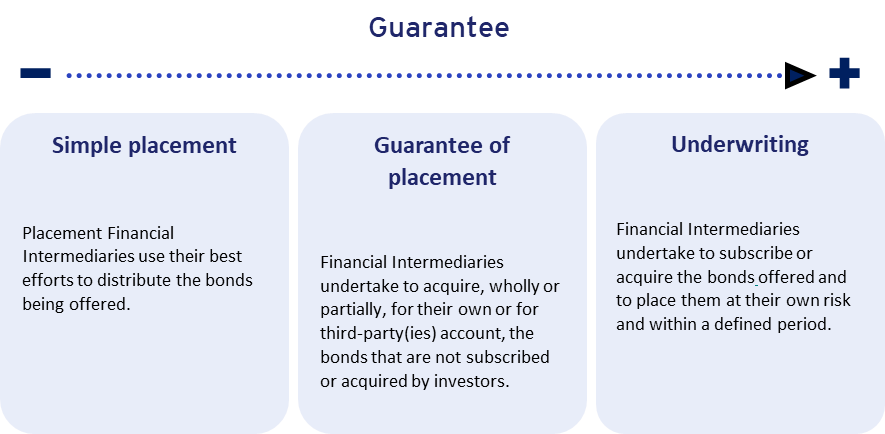
The negotiation of a placement agreement may require some time and should start early in the bond offering preparation phase. Signing must occur prior to the approval of the Prospectus by the Regulator.
4.1.1.2.1.5. Internal decision-making process
The decision to offering bonds to the public and related decisions during the bond offering journey require the prior approval of corporate resolutions during the Preparation phase, such as:
The general meeting of the Company is responsible for approval of the decision to issue bonds, except if its articles of association empower the board of directors with such competence. In any case, the resolution approving the bonds issue typically delegates power to the board of directors or managers to take decisions during the preparation process.
4.1.1.2.1.6. Engagement with the Regulator, the Stock Exchange and the Central Securities Depository
The applications for the Prospectus approval by the Regulator (in Portugal, the CMVM), for the listing approval by the Stock Market Operator (in Portugal, Euronext Lisbon) as well as for the registration of the Company’s bonds with the Central Securities Depository (in Portugal, Euronext Securities Porto) should be filed with a set of legal and financial documents set out in the applicable laws and regulations.
It is recommended that the Company, and its advisors, engage with these entities in an early stage of the Bond Offering journey for a smooth and timely approval procedure.
4.1.1.2.2. Due Diligence
Contrary to what occurs in equity offerings, in bond offerings the due diligence will normally only take place in case there is either an underwriting of bonds by the arrangers or some sort of offering / roadshow to institutional investors, normally at the request of the underwriters or these investors. Furthermore, since bond offerings do not entail a change of the issuer’s shareholding structure, the scope of this due diligence is usually more restricted than equity offerings’ due diligences, including only financial, commercial, legal, accounting and tax matters that may be deemed key by the underwriters or institutional investors.
This process is intended to provide knowledge of the Company, allowing it to correct any issue before the offering of its bonds and supporting it with strengthening of its business and corporate governance practices as well as ensuring that the required information about the Company will be disclosed in the Prospectus. Throughout the Bond Offering process, additional due diligence sessions may be planned at each key milestone to ensure that the information disclosed is up to date.
Recommended reading: 4.1.1.2.3. Prospectus.
Why should a Due Diligence be performed in the context of a Bond Offering?
The purpose of conducting a Due Diligence process in the context of a Bond Offering may be to:
As a best practice all information included in the Prospectus should be tied to a source document that was duly analysed during the Due Diligence and confirmed by the Company’s board, management of the Company and its external advisers (legal, accounting and any others as appropriate).
4.1.1.2.3. Prospectus
If you decide to proceed with a Public Offering in which the offer size and/or structure does not meet one of the exemptions presented in section ‘4.0. Road to Debt offering’ and/or you will request admission of the offered bonds to a Regulated Market, you will have to prepare and disclose to the public a Prospectus approved by the Regulator, drafted in accordance with the EU Prospectus Regulation.
Public offers and/or admission of bonds to a regulated market may be exempt from the obligation to publish a Prospectus in the following cases:
What is the Prospectus?
The Prospectus is a legal document, which provides to potential investors and analysts all material key information that may affect the investment decision. The Prospectus includes legal, financial (both historical and prospective financial information) and commercial information with contents adapted to the Company’s profile and bonds.
This document enables investors to clearly assess the Company’s patrimony, financial situation, results, and prospects. The Prospectus must be complete, understandable, and consistent. Once approved by the Regulator, it will be published prior to the bond offering or admission to trading.
The Prospectus may be drafted as a single document or as separate documents, dividing the required information into:
Summary*
The summary should be drawn up in a standardised format and in a concise manner, using simple language to make it easier to understand.
The summary should contain i) key information regarding the risks of the Issuer and the bonds that are being offered, ii) the offer’s terms and conditions, and the reasons for the offer and the allocation of revenues.
*The summary may not be required.
Registration Document
Document presenting the Issuer, its sector and business activities, including risk factors, assets and liabilities, accounting and financial information, management, and corporate governance, among others. It contains the information that will subsequently be shared with investors and analysts through the media, ensuring fair and equal diffusion to all parties.
Securities Note
Document defining the main terms of the transaction and information on the bonds that are being offered and / or intended to be admitted to trading, including the number of bonds, the distribution price, the relative seniority of the bonds in the Company’s capital structure, the interest rate and maturity date, a calendar for the offer, and the use of proceeds.
What is an EU Growth Issuance Prospectus?
Considering the specificities of the different types of bonds, Companies, offers and admissions, the EU Prospectus Regulation foresees different types of Prospectus, such as the EU Growth Issuance Prospectus. This is a simplified Prospectus for certain companies, which must consist of a single document with a maximum of 75 pages and less information, reducing the administrative burden of the process and associated costs, and making it easier for these companies to access the capital markets.
The EU Growth Issuance Prospectus may be used in the case of an IPO on the Euronext, Euronext Growth, or Euronext Access markets.”
In what context can a company choose to draw up an EU Growth Issuance Prospectus?
The EU Growth prospectus may be used by companies that do not have securities admitted to trading on a regulated market and which are:
► Companies with a market capitalisation of less than €200 million (if listed) or which, according to their latest annual or consolidated accounts, meet at least two of the following three criteria: an average number of employees during the financial year of fewer than 250, a total balance sheet not exceeding €43 million, and a net annual turnover not exceeding €50 million (if not listed).
► Companies, other than SMEs, whose securities are traded or will be traded on an SME Growth market;
► Companies, other than those referred to above, where the total aggregate value in the Union of the securities subject to a public offer is less than €50 million, calculated over a 12-month period, provided that such companies do not have securities traded on an MTF and have an average number of employees during the previous financial year of no more than 499.
The EU Growth Issuance Prospectus contains concise and proportionate information necessary for investors to understand, in particular:
a) The prospects and financial performance of the issuer and any significant changes in its business and financial situation that have occurred since the end of the last financial year, as well as its growth strategy;
b) Key information about the securities, including the rights attached to those securities and any restrictions thereon;
c) The reasons for the issuance and its impact on the issuer, in particular on its overall capital structure, and the use of the proceeds.
EU Follow-on Prospectus
The EU Prospectus Regulation allows companies to choose to draw up a simplified Prospectus for secondary offers, with a maximum of 50 pages — the EU Follow-on Prospectus — aimed at facilitating fundraising in the capital markets, reducing the cost of capital, and avoiding unnecessary burdens for companies.
When may a Company opt to draw up an EU Follow-on Prospectus?
The following companies may opt to draw up a simplified Prospectus:
► Issuers with bonds admitted to trading, for at least 18 months, on a regulated market;
► Issuers with bonds admitted to trading, for at least 18 months, on an SME Growth market;
► Issuers wishing to admit shares fungible with others already traded for at least 18 months on an SME Growth market;
► Offerors of bonds admitted to trading, for at least 18 months, on a regulated market or on an SME Growth market.
The EU Follow-on Prospectus must contain all the information necessary for investors to understand:
a) The prospects and financial performance of the issuer and any significant changes in its business and financial situation that have occurred since the end of the last financial year, where applicable;
b) Key information about the securities, including the rights attached to those securities and any restrictions thereon;
c) The reasons for the issuance and its impact on the issuer, in particular on its overall capital structure, and the use of the proceeds.
What is the passport of a Prospectus?
As EU Prospectus rules are similar in all Member States, once a Prospectus has been approved in one EU country, it is valid throughout the EU (through the passport mechanism). This represents an important simplification for Companies since allows Companies to launch offers or admit to trading debt instruments in several EU countries, resorting to the same Prospectus, provided that the Company requests the Regulator approving the Prospectus to send it (passport) to the Regulators of the relevant Member States.
What is CMVM approach?
CMVM recognizes that streamlining the conditions for issuers to access financing through capital markets, together with ensuring high quality standards for information to be provided to investors, generates trust and is a key element for the development of the Portuguese capital markets.
In the context of public offers or admission to trading processes, CMVM assumes as a priority the commitment with specific approval dates and the agility in reaction times to analyse Prospectus and recognizes the importance of calendars’ predictability as essential conditions for a smooth Prospectus approval processes.
Predictability & Timeline
– Interactions and approval according to a calendar previously agreed with the Issuer;
– Clear comments and understandings (in writing) – focus on the crucial information for investors;
– Quick responses to projects — the CMVM undertakes the commitment to respond swiftly, for the benefit of the procedure.
Availability & Agility
– Kick off meeting (if requested) before preparing and submit the Prospectus and further meeting (as needed);
– Credible and responsive process, coupled with smooth and informal interactions during all the process.
Prospectus process
The Prospectus must have a maximum of 300 pages and include complete, true, current, clear, objective, and lawful information relating to the following aspects, among others:
The CMVM will be available to clarify any questions during the process of drawing up the Prospectus.
What information needs to be included in the Prospectus?
Business Description
The Prospectus provides a brief history of the business and a timeline of key-events of the company across time. It also contains details about the Company’s incorporation and an explanation of the Company’s strategy.
The Company’s core economic operations are also described in the Prospectus, informing potential investors about the goods and services it offers as well as any recent changes to its business model.
Risk Factors
The Prospectus must disclose all material risk factors that may affect the Issuer and its bonds. If a Due Diligence process takes place, risk factors may be identified during such process.
Management Profile
The presentation of the Company’s management team is also included in the Prospectus. Their background, their remuneration, and their potential link to the issuer’s performance must be presented.
Issuer’s financial data
The Prospectus must include the Annual Accounts for the last two financial years (or such shorter period as the Company has been in operation).
All historical financial information must be audited and certified by a Charted Accountant. Additionally, in case there is a material change (usually a transaction), additional financial information may need to be disclosed, namely, on how that event affected the financial position of the Company.
Deal Structure
A description of the offer must be included in the Prospectus, allowing investors to understand the characteristics of the offer and features of the bonds (including the rights attributed to bondholders).
Language
Prospectuses for public offers in Portugal are mostly drafted in Portuguese, although prospectuses drafted in English are also common, with a summary version in Portuguese, if necessary.
Tax information
The Prospectus must include a warning that the tax laws of the investor’s Member State and the Issuer’s Member State of incorporation may affect the income received on the bonds.
Credit ratings
It must be disclosed, if applicable, credit ratings assigned to the bonds at the request or with the cooperation of the issuer in the rating process and a brief explanation of the meaning of the ratings if this has previously been published by the rating provider.
Profit forecast
Although not mandatory, it may be recommended (or, in certain cases, if already disclosed, it may be mandatory) to include in the Prospectus, as this is relevant information for investors, prospective financial information in the form of a financial performance forecast.
Offer price and intended use of proceeds
It is allowed not to mention, in the Prospectus, the final offer price and/or the final number of bonds offered to the public, provided that:
· The Prospectus discloses the criteria, and/or the conditions applicable in the determining the offer price and quantity of bonds or, the maximum price and amount of shares to be offered; or
· Acquisitions or subscriptions may be withdrawn for a period of no less than three working days following disclosure of the final offer price and the amount of bonds offered.
Once the definitive offer price and the final number of debt securities offered have been determined, these must be notified to the CMVM and disclosed.
Since the issuance of financial instruments is intended to raise capital in order, for example, to finance a major investment by the Company (e.g., expanding its operations into other geographies, acquiring technology, producing a new product line), the Prospectus must include information on the intended use of the proceeds of the operation.
Companies should meet, early in the process, with the Regulator to present the main features of the offering and to agree on an indicative timetable for the Prospectus approval procedure. These interactions are extremely important for a smooth procedure and to agree on the calendar for the versions of the draft Prospectus to be submitted to the CMVM as explained above in “What is CMVM approach?”
What is the timing for the Prospectus approval?
Prospectuses must be approved within a maximum period of 90 business days. In the case of small and medium-sized enterprises (SMEs), this period is longer, and may reach 120 business days.
If necessary, and upon request of the interested party, these periods may be further extended by an additional period of up to 30 business days⁴.
However, CMVM presents a track record of substantially shorter timeframes — aligned with a calendar agreed a priori with the issuer — depending on the degree of completeness of the versions submitted.
CMVM periodically publishes the timeline of its reviews in the context of the Prospectus approval procedures, in line with its public commitment to a swift, predictable, and transparent process, ensuring that the in-depth review process takes into account the financing needs of companies and market opportunities.
4 Entry into force still subject to the adoption of delegated regulation.
Below you can find data on the average timeline for CMVM reaction to the multiple versions of Prospectus supplements and securitization transactions:
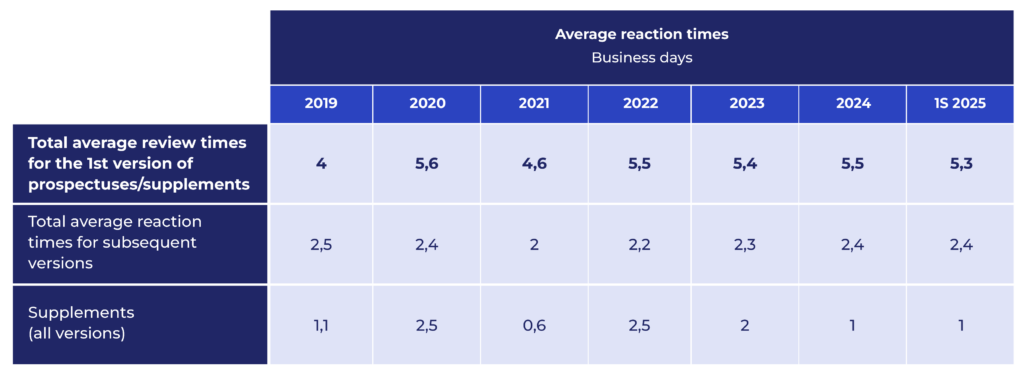
*Monitoring began in 2021.
The CMVM conducts a thorough review to verify the adequacy of the Prospectus with the legal requirements relating to its content and form, particularly by examining the completeness, comprehensibility and consistency of the content, and to ensure that the Prospectus contains all the information needed for investors to make an informed decision.
This review period starts when a first draft of the Prospectus is filed with the Regulator. Afterwards, through an interactive and streamlined process, the Prospectus is revised and a final version is submitted for CMVM’s approval, in accordance with the calendar and the Company’s needs.
The approval of the Prospectus implies a verification of the completeness, consistency and comprehensibility of the information Included in the Prospectus. The CMVM will ensure that all the information contained in the Prospectus meets the minimum requirements for investors to be able to make informed decisions about the bonds.
Once the CMVM grants approval, the Prospectus is published on CMVM’s website. All approved Prospects are published on CMVM’s website, which provide examples prior to start drafting the Company’s Prospectus.
Once approved, the Prospectus must be made available to the public at a reasonable time in advance of, and at the latest at the beginning of, the offer to the public or the admission to trading of the bonds involved. Click on the button below to find out where the Prospectus must be published.
Where must the Prospectus be published?
The Prospectus must be made available to the public in electronic form on any of the following websites:
a) the website of the Issuer, the offeror or the person asking for admission to trading;
b) the website of the Placement Financial Intermediaries placing or selling the bonds, including paying agents;
c) the website of the Stock Market Operator where the admission to trading is pursued;
d) the website of the Regulator who as approved the Prospectus.
The Prospectus must be published on a dedicated section of the website which is easily accessible when entering the website. It must be downloadable, printable and in searchable electronic format that cannot be modified.
Once approved, the Prospectus must be made available to the public within a reasonable period, i.e., no later than the start of the public offer or the admission of the Company’s shares to trading.
Where must the Prospectus be published?
The Prospectus must be made available to the public in electronic format, on any one of the following websites: a) the website of the Issuer, the offeror, or the person requesting admission to trading on a regulated market; b) the website of the Placing Financial Intermediary or the party responsible for the sale of the securities, including the paying agents; c) the website of the Regulator that approved the Prospectus.
The Prospectus must be published in a specific section of the website, easily accessible to the public. The Prospectus must be capable of being downloaded, printed, and searched, and made available in a format that cannot be modified.
Validity
The Prospectus for a Public Offering for distribution remains valid for a 12-month period from the date of their approval by the CMVM, and provided the Prospectus is updated accordingly with any supplements that may be required. In particular, a base Prospectus might be a relevant and very interesting tool providing companies with sufficient flexibility to fulfill emerging financing needs throughout a period of 12 months after its approval, and the publication of a supplement is not mandatory for the incorporation by reference of new financial information (annual or half-yearly).
Supplements
It is possible that, between the moment the Prospectus is approved and the moment trading begins on a regulated market, a significant new fact, a material error, or a material inaccuracy relating to the information contained in the Prospectus that is capable of influencing the assessment of the bonds may occur or be detected.
In such cases, the Company must prepare a supplement with the necessary information and request its approval by CMVM. The approval process for supplements takes into account the extreme importance of a swift review by CMVM, so as to mitigate potential disruptions associated with that event. Supplements are approved swiftly following the occurrence of any relevant event, granting investors the right to withdraw the subscription orders they have already submitted.
Where the significant new fact, material error, or material inaccuracy arose before the close of the offer period, investors who have already accepted the offer (before the disclosure of the supplement) will have the right to withdraw their subscription within three business days following that disclosure. This period may be extended by the Company. The final date for exercising the right of withdrawal is indicated in the supplement.
4.1.1.2.4. Listing application
In order for a Company’s bonds to be admitted to trading, a request for the listing of the bonds must be submitted to the stock market operator. In Portugal the operator is Euronext Lisbon, who will verify compliance with the general requirements for admission to trading.
Recommended reading: 3.1.1.1.2. Eligibility criteria.
In case of listing in Portuguese markets, to kick-off the admission to trading process, the Company first meets with Euronext to present the listing project and agree on a timetable regarding the admission to trading process.
The Company must appoint a Listing Agent (Euronext Lisbon) and a Listing Sponsor (Euronext Growth and Euronext Access) who will assist and guide the Company with the admission to trading and also help the Company to prepare the application form and all the documentation that must be submitted to Euronext Lisbon.
At the same time as the proceedings above, the Company needs to register its bonds with the Portuguese Centralised System of Registration of Securities managed by Euronext Securities Porto.
Decision
Euronext will decide on the application for admission to listing within a maximum period of 30 trading days (1 month for Euronext Growth and Euronext Access) after receiving the required documentation, unless agreed otherwise by the applicant Company and Euronext Lisbon.
In the event of a Public Offering of bonds, the admission to trading shall become effective only after the assessment of results and settlement of the offering.
4.1.1.2.5. Marketing and Communication Planning
Marketing and Communication strategy throughout the Bond Offering process is crucial as it enables the Company to manage investor relations; generate interest and mitigate perceived uncertainty.
In the context of a Bond Offering, it is of paramount importance that the Company, with the assistance of its advisors, diligently defines how to present and promote the offer to potential investors.
While the Prospectus is being drafted, a marketing strategy is designed to create investor interest and momentum. The Company and its advisors may draw up a presentation to use in meetings with investors, which includes exclusively contents presented in the Prospectus.
Marketing documents may be prepared, according to the type of offering, such as slideshow, dedicated websites, press releases and other communication materials, which may all be adjusted throughout the Bond Offering process.. Documents comprising advertising content are subject to prior approval by the CMVM.
The marketing strategy has a great impact in managing investor relations, generating interest and mitigating perceived uncertainty.
It should be highlighted that material information provided, directly or indirectly, by the Company to Institutional Investors or special categories of investors, including information disseminated at meetings, as well as information provided to financial analysts shall be disclosed to all investors to whom the offer is addressed.
Until the offer is made public, all the parties involved in its preparation need to:
As from the moment the offer is made public, all the parties involved in releasing information regarding the offer need to:
Additionally, when conducting pre-offering marketing activities, such as the ones described above, all the parties involved in the Offer need to assure the compliance with the EU Market Abuse Regulation (“MAR”) in what respects disclosure of inside information the context of a market sounding.
Recommended reading: 5. Life as a Company with securities admitted to trading.
4.1.1.2.6. Early-look meetings with investors
The targeting of investors in debt offerings is not exactly the same as in an equity offerings. Whereas in the latter it is more common to have an offering to institutional investors (in parallel with the Public Offering) that plays a key role in the process and the success of an IPO, notably in the price determination thought the bookbuilding method, the role of these investors is much more limited in debt issuances.
This is without regards that the investors may be consulted, at an early stage, to assess and attract their interest in the issuer and bond issuance and, thus, help set the offer price.
Considering the offer structure, it may be advisable to prepare the Company’s Management for any meetings with potential investors (either internally or through a communication agency or other advisors) in order to create adhesion by investors.
These one-on-one confidential early-look meetings between Management and targeted investors aim to introduce the Company, explain its business model, assess the initial market sentiment on the Company’s story, ask for the investors’ feedback on several matters, such as the Bond Offering and the bond price, to understand how the market will assess and value the Company.
These early-look meetings may allow an early assessment of the potential success of the Bond Offering. Based on the potential interest noticed at these meetings, which may be spread out over time, the Company may adjust its Bond Offering project, and can postpone or even exit the process without a substantial financial commitment at this stage.
If the meetings generate a formal commitment of acceptance of the Offer, this information will appear in the Prospectus.

